
What a language model actually costs to run
A token is a chunk of text, roughly four characters or three quarters of a word. Tokens are what you are billed for, and the unit almost everything else is measured in. Here are the numbers that decide the bill, from list prices and measurements taken in September 2026, each with its source.
A model’s price list looks simple: so many dollars per million input tokens, so many per million output tokens. Input is the text you send, output is the text the model writes. The monthly invoice comes from several numbers multiplied together, and getting one wrong moves the result by an order of magnitude. Here is each in turn, with prices checked on 21 September 2026.
Price per million tokens varies more than a hundredfold
Within one provider’s price list, the gap between the dearest and cheapest model is more than a hundredfold. OpenAI charges $10 per million input tokens and $50 per million output tokens for GPT‑6 Astra, and $0.05 and $0.40 for GPT‑5 nano. On output that is 125 times cheaper. At Anthropic, Claude Fable 5.1 costs $10 and $50, Claude Sonnet 5 costs $2 and $10, and Claude Haiku 4.5 costs $1 and $5. Google charges $0.30 in and $2.50 out for Gemini 3.5 Flash‑Lite. DeepSeek charges $0.30 and $1.20 for deepseek-flash at peak hours.
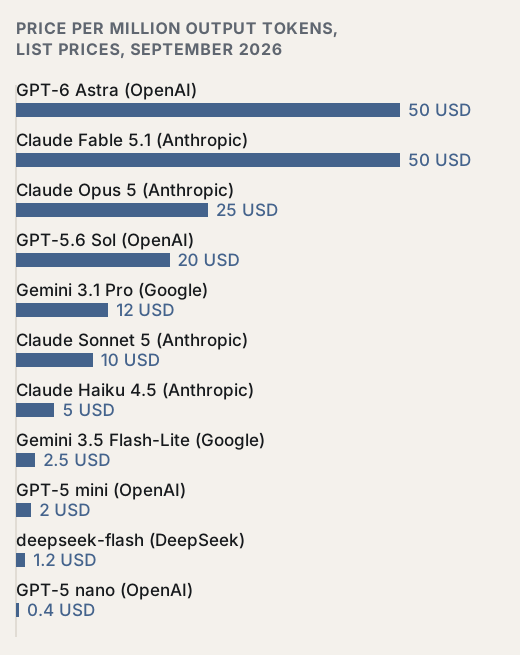
Across these price lists, output costs four to more than eight times what input costs. Answer length therefore matters more to the bill than question length, and it is the first thing to trim once costs climb.
How many tokens one run of a process consumes
The price per million tokens means nothing until you know how many tokens one task uses. Anthropic publishes a worked example: one customer support conversation averages about 3,700 tokens, and ten thousand of them on Claude Haiku 4.5 comes to roughly $37.
- One token is about four characters, or three quarters of an English word, according to Anthropic’s documentation.
- An average 10 kB web page is about 2,500 tokens, a 100 kB documentation page about 25,000, and a 500 kB research paper in PDF about 125,000 tokens.
- Tool definitions, meaning the descriptions of functions the model may call, are billed too: a browser toolset adds about 6,600 input tokens to every request, a computer toolset about 4,500.
- A one-hour coding session on Claude Opus 5, with 50,000 input tokens and 15,000 output tokens, costs $0.625 in tokens alone.
The context window is larger than the part the model uses
The context window is how much text the model can take in one request. Claude Opus 5, Claude Sonnet 5 and Claude Fable 5.1 have a one million token window, roughly 750,000 English words. Measurements show the usable part runs out much earlier. NoLiMa, presented at ICML 2025, tested thirteen models claiming at least 128,000 tokens of context. At 32,000 tokens, eleven of them fell below half of their own short-context score, and GPT‑4o, one of the strongest in the set, dropped from 99.3% to 69.7%.
Earlier work says the same in different words. RULER tested seventeen models and found that, among those claiming 32,000 tokens or more, only half held up at that length. “Lost in the Middle”, in Transactions of the ACL, showed that a model finds information best when it sits at the start or the end of the input, and does markedly worse when it sits in the middle. Anthropic states it plainly in its own documentation: as the token count grows, accuracy and recall degrade, a phenomenon it calls “context rot”.
A very large context window is a safety margin rather than a working method. Dropping an entire knowledge base into one request is both the most expensive option and the least effective.
Latency is two numbers, not one
The first is time to first token: the seconds between sending the request and the first fragment of the answer appearing. The second is output speed: how many tokens per second the model writes after that. Those are the definitions Artificial Analysis uses, a service measuring models independently of providers. NVIDIA adds that time to first token includes queueing, processing the whole input and network latency, so it grows with the prompt, meaning the instruction you send the model.
Users feel the first of those two numbers. Jakob Nielsen set out three thresholds for system response: 0.1 seconds for feeling the system reacts instantly, one second for a user’s flow of thought to stay uninterrupted, ten seconds for holding their attention. In Artificial Analysis measurements the lowest latency belongs to the older, lighter Gemini 2.5 Flash‑Lite without reasoning, at 0.30 seconds. Reasoning models, which work through a problem internally before answering, sit on another scale: at maximum effort the first token of the actual answer arrives after 291 seconds on Claude Fable 5.1 and 258 seconds on GPT‑6 Astra. In an overnight job that does not matter. In a chat window it decides everything.
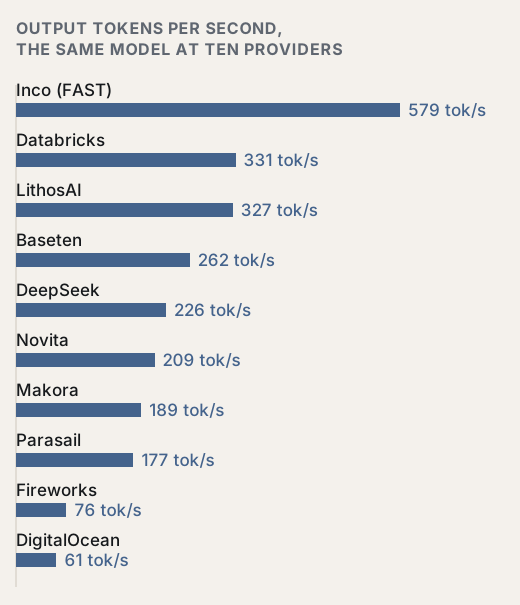
Output speed depends on who serves the model as much as on the model. The same DeepSeek V4.1 Flash measured at ten providers ranges from 61 to 579 tokens per second, and time to the first fragment from 0.76 to 1.81 seconds. With identical weights, the provider changes what the user feels more than the model does.
When the cheaper model is the right answer
Anthropic’s own documentation is direct about it: the cheap model for simple tasks, the mid tier for most production workloads, the dearest for the hardest reasoning. Independent measurement agrees. In the Artificial Analysis comparison, Claude Fable 5.1 scores 53 on the intelligence index at $7.175 per million tokens, while Muse Spark 1.3 scores 48 at $0.78. Five points of quality cost more than nine times as much.
- Reasoning tokens are billed as output tokens, once, when they are generated, so a reasoning model raises the bill even when the visible answer is short.
- The context window counts everything: the system prompt, the whole conversation history, tool results, images and documents, and the output the model is about to write.
- Caching does not reduce context window usage. It changes what those tokens cost, not whether they take up space.
- The only test that counts is your data, against a quality bar agreed before anything is switched on.
The discounts that change the arithmetic
Two mechanisms move the bill further than switching models does: caching, a stored copy of the repeated opening of a request, and batch mode, processing with no guarantee on response time.
- At Anthropic a cache write costs 1.25 times the input price for a five minute lifetime and twice the input price for an hour, while a read costs 0.1 of the input price, or 0.025 on Claude Fable 5.1 and Mythos 5.1. The write pays for itself after one read on the five minute option and after two on the hourly one.
- OpenAI enables caching by default, discounts repeated tokens by up to 90%, requires a shared opening of at least 1,024 tokens, and keeps an entry for 30 minutes after its last use.
- At DeepSeek a cache hit costs $0.006 per million tokens against $0.30 for a miss, fifty times less.
- Batch mode takes 50% off at OpenAI, Anthropic and Google. OpenAI commits to completion within 24 hours, up to 50,000 requests in one batch, drawing on a separate pool of rate limits.
- The discounts stack. In Anthropic’s worked example, a one-hour session on Claude Opus 5 drops from $0.625 to $0.445 in tokens once 40,000 of the 50,000 input tokens come from cache.
What these numbers do not promise
Every price here comes from a list checked on 21 September 2026, and they will move. Google’s price list says so in writing: Gemini 3.8 Flash costs $0.75 per million input tokens through 31 December 2026 and $1.50 from 1 January 2027. Movement goes the other way too. Anthropic cancelled the rise for Claude Sonnet 5 from $2 and $10 to $3 and $15 scheduled for 1 September 2026.
Price per token is also not fully comparable between models, because models cut text into tokens differently. Anthropic warns on its pricing page that models from version 4.7 onwards use a new tokeniser producing roughly 30% more tokens for the same text, so a cheaper list price can produce a larger invoice. Work by Petrov and colleagues at NeurIPS 2023 showed the same text translated into different languages can differ in token length by as much as fifteen times, and tied that to the cost of commercial services. Count tokens on your own material, in the language you work in, before adopting anyone’s price list as your own.
The speed measurements belong to someone else. Artificial Analysis reports medians from its own workloads: tests at one thousand and ten thousand input tokens eight times a day, and a hundred thousand token test weekly. Your prompt, region and traffic pattern will give different values. The NoLiMa and RULER results are likewise results on their authors’ tasks, not your documents.
If you want these numbers worked out for one process in your company, write to us. Turning a price list into a monthly figure takes one process description and a sample of its data.
Sources
- 01OpenAI, API pricing
- 02Anthropic, Claude API pricing
- 03Google, Gemini API pricing
- 04DeepSeek, API pricing
- 05Artificial Analysis, model intelligence and latency comparison
- 06Modarressi et al., NoLiMa: Long‑Context Evaluation Beyond Literal Matching, ICML 2025
- 07Hsieh et al., RULER: What’s the Real Context Size of Your Long‑Context Language Models?